

In this solo episode, I dive into what it truly means to live a choiceful life, and why so many of us are living by default without even realizing it.
I share my own journey of breaking free from a prescribed path and how a single piece of advice from a mentor sparked a philosophy I’ve built my life and work around. We explore how to adopt an active posture toward your life, ask better questions, and find possibilities you didn’t know were available to you.
I also walk you through how I protect daily discretionary time for deep thinking and creativity, and I challenge you to try just 10 minutes a day to start building a more intentional life.
Whether you’re navigating a major life transition, craving more purpose in your day-to-day, or simply ready to stop drifting and start deciding, this episode will give you both the perspective and the practical steps to move forward.
Don’t miss this invitation to step into the life you actually want.
Show notes:
Follow me on:
- Instagram @stacyennis
- Facebook @stacyenniscreative
- YouTube @stacyennisauthor
To submit a question, email hello@stacyennis.com or visit stacyennis.com/contact and fill out the form on the page.
How to start living a choiceful life | Episode 241 Transcripts
These transcripts were generated by robots, not writers.
Stacy: Hello and welcome. It is just you and me this week, no guest. And today what I want to talk about is living a choiceful life. I’ve shared in previous episodes that I am working right now on a book called Choiceful. It is all about how to really harness creative productivity and build a life that you truly love. And as I’ve been working on this book, it’s really interesting because on the one hand I am writing it for you and for future readers, but on the other hand, it’s a really important experience of self reflection for myself as I go through writing this book. It’s also been really helpful for me to do the thing that I help my clients do, which is introspect, and then create something that other people can understand and use.
Stacy: And so as of this recording, I just wrote part of chapter four, which is all about the myth of choice. So in today’s episode, what I want to talk to you about is what that myth is and how you can start to build choice into your everyday life. So we’ll talk about why your life right now might be choiceless or not necessarily choiceless, but maybe you’re not approaching life from a posture of choice and how perhaps you could begin to build more choice into your everyday life. And I say that knowing that some of you listening to this or watching this on YouTube have very choiceful lives and you’ve built a lot of choice in and yet there are still opportunities to examine our lives and ask, am I defaulting or am I choosing?
Stacy: And so my invitation to you is that even if you’re listening and you feel like I choose so much of my life and I really approach life from a mindset of choice, maybe today there will be one thing that you examine through this conversation that helps you see even more abundance of choice in your life.
Stacy: So let’s start out with talking about the myth of choice. So many of us were raised in communities, in societies, in homes where our lives were laid out for us. Now, whether that was explicitly stated to us like here is your pathway, or it was simply that we only had one version of what the future could look like. Our lives were essentially laid out for all of us.
Stacy: There is a roadmap that if we follow that roadmap, if we check all the boxes, we are successful. For me, what that looked like was following the conservative Christian playbook. I grew up in a Christian school. I went to the same church. So the overarching church body was my school. And it was also my church, which actually has a lot of issues in that way, if you think about it. Because I was never in an environment that was free of this mindset that prevailed in this environment. Now, I am not saying that Christian environments are bad. There are many that are very positive. And I’m going to remove my home life from what I’m about to say because I have wonderful parents and I know they listen to this and I would never want them to think that I am talking about them.
Stacy: But I want to really drill into this water that I swam in growing up. So I was in an environment where it was very patriarchal. We were really raised to be stay at home moms. We were not valued as thinkers and leaders in our community the way that boys and men were. And were constantly policed with our bodies. And I have this really particular memory of sixth grade and were in class and the teacher said at recess time. So this is the thing we all look forward to every day, boys, you can go out to recess. Girls, I want you to stay here. And all of us girls were looking at each other like, oh, what’s this about? And of course, you know, we’re hoping that it’s something good, something positive.
Stacy: But instead, the teacher stood up at the front of the classroom with a very stern look in her eyes, and she said, girls, I want you to know that I can see up your shorts while I am teaching this lesson. And that means that the boys can see up your shorts and it’s not appropriate. And you need to make sure that you’re wearing appropriate clothing when you come to school. Now imagine being 12 and never once having thought about how my body might be perceived in a school environment by anybody, let alone my female teacher. Let’s say first of all, and the other boys in my class, I was just there to learn and to play and to be a kid. I wasn’t thinking about what’s up my shorts and whether people can see me.
Stacy: And so from very young, I was raised in an environment where I was controlled. I was monitored. I was told what I could and could not do. I was constantly shamed for talking too much, for being too much. And I was also taught that the path that I needed to take was to go to college, to get a husband, to have kids, and not necessarily to have a career. I could have a career, but I could only have a career if my kids weren’t put in daycare. And then the next thing is, you buy a house and you send your kids to maybe that same Christian school. And on and on and on it went. So my roadmap was that was what I was handed. And while in my family, it was expected that we would go and get master’s degrees.
Stacy: That was just kind of the level set. I always figured I would get one. It wasn’t necessarily assumed that I would skyrocket professionally or that would be one of the most fulfilling things in my life. And it has been. I mean, I love my home life, and I love my family. I love being a mom. I love being a wife. I love all those things that I have now. And my work is so deeply rewarding. I get to do what I love every day, and I do not take that for granted. I never knew as a kid that I would get that opportunity in my life, that my career could be this deeply fulfilling. And so the way that I started to remake my own possibility, my own roadmap, was through books.
Stacy: And I’ve had a few people ask me this, but one particular friend once asked me, stacy, how did you think to go do the things that you’ve done when you grew up, where you grew up? Because she grew up in the same town I did, in Boise, Idaho. It’s 87% white. It’s affluent, it’s a nice place. But we’re not really encouraged to travel internationally to build these careers for ourselves, to impact at the level that I feel so grateful to have been able to impact people. And it really was through books. That’s part of why I’m so passionate about the work that we do, because books can change lives. So through books, as a kid, I was able to travel to Narnia. I was able to travel to New York City. Space. You know, I could go all of These cool places.
Stacy: I never had to leave my cozy home, but I could travel in my mind. And I started to challenge the intellectual constraints that had been placed on me, the patriarchal boundaries that had been given to me and that just kept growing and growing. And I started discovering Chicana writers and black writers and disabled writers and all of these identities and experiences, life experiences that I had never had. And then I started traveling. I took my first job outside of the US when it right after graduating college, I moved to the Caribbean. And so there’s all these different ways over time that I have really learned to integrate choice into my life. And I have to say that alongside the books, having a really wonderful mentor who’s become a really dear friend was a big part of that.
Stacy: We were on a walk once I was making a decision that was. Felt really hard for me at the time. I think I’ve talked about this a little bit on the podcast and she said to me a line that came from her mentor and she said, you know, Stacy, you make a choice and then you make another one. And that is really the foundation of what it means to live a choiceful life. When you live a choiceless life, you either default into the pathway that was given to you with no introspection. So I’m not saying that if you introspect and you do explore and you truly choose that pathway, that’s valid, that’s absolutely valid. You’re choosing. But if you simply default with no introspection and no real questioning of whether that path is right for you, that is defaulting.
Stacy: When you have a posture of choice, you can look at something that seems to not hold options or seems to only have binary options, and you might say, okay, what is the third way? What other options do we have? And this is really an entire life changing philosophy that if you really can adopt this choiceful posture, this choiceful mindset, life opens up. It opens up and there is so much possibility and opportunity in front of you. And I really think it boils down to asking that question, what choice is available to me that I haven’t explored or that doesn’t seem immediately obvious? And it might mean that those choices are not the choices that you want to make. But there is always choice.
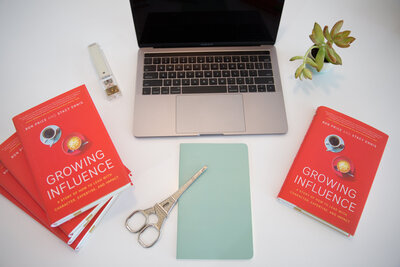
Stacy: Always, always there is a choice, at least for those of us who are privileged enough to live in developed countries and have the kind of opportunity that we have in these developed countries. Really foundational to a choiceful life is lifestyle design. So when I guide people through this process of really taking ownership of their lives and building in choice. We start with vision, and then we look to lifestyle, and we look at lifestyle and we examine how you’re spending your days. And if we really boil down to it, then the question that we’re asking is where am I making space for discretionary time? My co author, Ron Price, and I wrote about discretionary time in our book Growing Influence, which is a book that I still love and I’m so proud of. We’ll be sure to link to it in the show notes.
Stacy: And really, discretionary time is space that you build into your life for deep thinking. I really believe that a lot of the reason that you may not feel like you have a lot of choice in your life or maybe you’re not immediately seeing the choice that’s available to you. There’s choice that’s maybe invisible to you right now is because discretionary time is so undervalued in our society. There is a good argument, scientific argument, actually, for creating consistent daily discretionary time. And by discretionary time, what I mean is really that space for deep work, creative work, learning, and really introspection and creation. My discretionary time is typically used for writing, but sometimes it’s used for building things. It might be used for building a course, a strategy, a schedule.
Stacy: So, for example, I am in the throes of planning my amazing retreat this November for writers here in Portugal. Portugal. And I will use my discretionary time for building this schedule, for making sure that this schedule is exquisite and that these authors are going to have an incredible time here. And that space, because it is protected in my calendar, because it is something that I wrap my arms around like a mama bear, that is the foundation of a choiceful life. Why? Well, first of all, I am choosing to make that space for myself. I am creating this time on my calendar. I am protecting the time on my calendar, and I am using that time on my calendar for the thing that I want to use it for. That I am lit up by, that helps me be creative, that helps me think.
Stacy: And by creating space to think, I naturally create space to consider possibility. That’s just slightly what happens when we shut off the outside world, when we come to our inner world, and then we go from that inner world to create for others or to clarify, to journal whatever it is we’re doing at that time that naturally opens us up to possibility and opportunity. Now, I could go five hours talking about all of the different components of lifestyle design, and I’m going to be talking about these over many weeks to come as I write this book because I’m writing this book. And it will be in your hands in the near future. We’ll talk about that. I’ll give you a little update toward the end on where I’m at with that. And I don’t want to hold this information for you.
Stacy: I want you to be able to start implementing the things that I’m going to detail and give you templates and things for in the book. So I want to talk about what I’m doing right now with my discretionary time. I’ll give you some specifics about it and then I’m going to give you a little update on the book that I’m working on because I think also it’s interesting to see how that is progressing because I’m doing it during my discretionary time. So my discretionary time is typically for an hour each day. Now I look forward to being in a season where I can do more than that. And there have been seasons where I was able to put two to three hours a day into discretionary time. Right now that’s just not practical. I have clients, I get to serve.
Stacy: I have a team that I’m here to serve as well as a leader. And I have other things going on. So right now it’s an hour. That time for me right now is from 9 to 10. And that is because I have morning obligations like school drop off or I also have a fitness class I go to twice a week. And so that discretionary time is typically from that window of 9 to 10. But and this goes a little bit counter to the neuroscience, it does shift a little based on what’s going on that day. Now, a frustrating factor of my schedule is that my daughter goes to a Portuguese public school and they have different start times every day. Can you imagine? It’s crazy. So three days a week she starts at 8:30. Two days a week she starts really late.
Stacy: So the days that she starts late, my husband takes her and I start earlier with my discretionary time. So I might do it from eight to nine and sometimes I even get into full hours on those days because I have a little bit more time. Now here’s the thing you need to know about this discretionary time. It is not enough to just put the time on the calendar. You need to have some stacked habits to help you get into the flow of using that discretionary time. So for me, what that’s looking like right now is I’m using a meditation app. I do around a 10 minute meditation. I write down a couple lines of reflection from that meditation. And my meditation is really focused on abundance. It’s really focused on positivity, of seeing luck, of attracting luck, of building my biggest vision.
Stacy: It’s really around my dreams, my vision, building the life that I want. It’s really important for me that I’m in that mindset when I go into this time, that I’m thinking and creating. And so I do that. I have a journal, and I write down a couple. Sometimes just a sentence, sometimes a couple lines that really stayed with me from that meditation. And then I just write down three things I’m grateful for. And I just write I am grateful for blank. And it can be really simple or it can be really profound. And I don’t overthink it. I just write what comes to mind. And your process might look different. But for me, this is what I have been doing to help me get really nicely into the moment when I start to create.
Stacy: Now, I’m doing a little bit of overlapping priorities right now, which is not normally my recommendation. I am finalizing my book proposal, which I have a draft done, but I’m in the kind of tweak and finish stage, and then I’m writing the book as well. And so I’m kind of going a little bit back and forth between what I’m doing each day. But my goal right now is to get a chapter a week done. Now, I don’t recommend that for you, probably, if you’re writing a book, because, number one, I’m a really skilled book writer, and I work at a different pace than you will if you’re a new author. I mean, it’s just natural. If you have a skill, you’re going to be able to produce that skill better than somebody who hasn’t done it right. So that’s not my recommendation.
Stacy: For most people, normally two weeks is a good range for writing a chapter when you’re keeping a good pace and you’re consistently showing up for your writing process. And so I’m using a couple days usually to write and a couple days to work on my outline. And usually there’s one day that I don’t get a lot done. So five days a week, I might have one day where I want to have an hour, but for whatever reason, I just can’t that day. But I still show up and I might put in 30 minutes and I give myself that flex. I don’t hold myself religiously to five days a week. It’s my goal, but it’s okay, really. My ultimate is I need to get in four days a week. And I know I will progress. So this is how I’m using my discretionary time.
Stacy: And what’s been really cool about this, especially as I’ve been really refining and adjusting so I can make space for this book. Because on top of all my other things I was already doing, I was already making time for discretionary time and I was doing other things too. So I’m having to really work with this. And what I would say is that I still do another three hours, typically two to three hours of deep work after this. So I’m reading client books, I’m writing content for the platform, doing things like that. So let me bring this all back around to the topic in the beginning, and that is building a choiceful life. My decision, your decision to carve timeout. It doesn’t have to be an hour. Okay. It doesn’t have to be any number. It can be 15 minutes.
Stacy: To create space for thinking, for creation is you staking a claim in the ground and saying, I am making space. I am choosing to make space for my creative work. That is a radical act of creativity in our hyper connected world today, where there’s so much fear mongering, there’s so much attention stealing, there is so much around us that is vying for our attention. To say, I am taking this space to think and create, this is my deep work time and I am here for this. That is powerful. That is choice. You are making a choice.
Stacy: And the nice thing about this, and we’re going to talk more about this over time and as I keep writing and I want to share more of it with you, but this is really foundational to building an entire life of choice and recognizing that no matter the age you’re at, you still have choice. You still have possibility and potential and the ability to choose new pathways for yourself and to build new things for yourself. I get the honor of working with authors ranging from, you know, their twenties to their seventies and beyond. And what is so amazing about this is I get to connect with people who are at the early stage of their careers and at the end of their main career, but transitioning into their next possibility.
Stacy: And what I have learned, working with every stage, every age, from the most successful people you could imagine to people that have so much within them and haven’t really stepped into it, is that there is latent possibility within us. We have to make the choice to step into it. And a philosophy that is also really core to this book is a bias toward action. Making space for your Discretionary time is active. It’s not passive, it’s not dreaming. It is taking action. And so let me challenge you today. If you have not been consistently making space for thinking, creativity, whatever it is, I’m going to offer a little challenge to you just for five days. Five days. See if you can give yourself 10 minutes a day, just 10 minutes.
Stacy: And all I want you to do during that 10 minutes is you can do one of two things. You can either just sit, set a timer on your phone and just sit for 10 minutes and just close your eyes. Sit, sit in a place that you’re not worried about, you know, I don’t know, somebody coming in or whatever. So your attention’s really on that space. And just let your mind wander. You don’t need to be a Buddhist. You don’t need to empty your mind. Just sit and just experience your thoughts and just be. For those 10 minutes, if you want to maybe take that another step, you could actually write your thoughts down.
Stacy: So just take a journal and just kind of get out whatever’s in your mind that day and just journal for 10 minutes and see after those 10 minutes how this feels in your life. If it’s something that feels enriching. If you could see, start to get the seeds of this might open up something new for me. What if I could make it 20 minutes? And what if I put those 20 minutes toward my dream? I started pitching places or writing that book, or working on my art, whatever it is. What if you could start putting that space there? What if you could foster choicefulness through making a choice every day to be present with yourself. That is really the foundation of it, of a choiceful life. I am so fired up about this as I write this book.
Stacy: It’s so meaningful for me to get to pull together all of this time that I’ve spent not only working with people, but living this life myself, failing at times, learning from it, reading the research. And I am excited to keep sharing this with you and I hope that this is useful for you as you wait for this book because it’s going to be a while. You know how books go. On that note, let me give you a little update on my book writing process. So I mentioned I just finished chapter four. I’ve shared before that I am doing this a little differently. So I have in the past published. Traditionally it was with a small press, small advance.
Stacy: And then since then I’ve worked with lots of authors who have largely self published or hybrid published, but some that have gone and traditionally published and just Having now been in this industry for so long and really loving the space that I’ve been in that self publishing hybrid publishing space, but also having so many wonderful connections in the traditional space, I am really excited about exploring this pathway for myself. I’ve written my proposal, it’s in proofreading and it will be in design next week. So I can get it done by the end of next week and I’m going to get it out to some of my connections to agents and I’ll keep you posted on that journey of agent finding and what that experience is like.
Stacy: And let me know in the comments if you’re interested in this because I love to create for you. If you tell me that you want to hear more about something, I will talk about it more. And if you’re not that interested, say, stacy, go back to your regular content, talk about this thing. So just let me know what you want to hear. You can always leave a comment in whatever app you’re listening to this on or on my website@staceyannis.com you can click on the Blog and pod tab. And I want to thank today as always, Rita Dominguez for her production of this podcast. I know I say this every week, but I am not exaggerating when I say that she is 100% the reason that you’re listening to this. I know I had to record it. I had to show up for this part.
Stacy: But y’, all, this would just sit in Riverside, which is the platform I use to record. It would just stay there. I would not have the time to edit it. I would have a hundred other things to do. I’d work on the book instead of getting this out. She really makes it happen. So huge. Shout out to her. And since you’re still listening or watching, you must really have loved today’s conversation. So would you do me a solid and either follow me if you’re on YouTube or subscribe if you are on whatever podcast platform you use, and please rate and review because it makes such a huge difference in helping me reach more listeners with this philosophy of this podcast, which is living a life that’s not just better, but beyond better.
Stacy: And of course, at the core of that is living a choiceful life. And thank you so much for joining me today. Today I will be back with you before you know it.


Comments +